Annual Reports
PT Erajaya Swasembada Tbk's annual reports contain management's most considered account of the business. These are the sections, passages and visual pages worth opening in the originals preserved in Sources.
PT Erajaya Swasembada Tbk — 2025 Annual Report (Laporan Tahunan) — FY2025
The latest full-year account: 2,333 outlets, Rp76.6tn of sales at a 10.9% gross margin, and the year operating cash flow nearly vanished. · Open the full document →
LAPORAN DIREKSI / REPORT OF THE BOARD OF DIRECTOR — p. 22 · Read the full section →
Management's own account of 2025 — where the 'Consciously Grow' stance came from and how a supplier's calendar moved the year.
The President Director on how Apple's launch calendar reshaped the sales year.
Beyond market-related challenges, Management also faced operational challenges associated with principal business dynamics. The rescheduling of Apple’s key product launches from October 2024 to April 2025 was managed through careful inventory oversight and proactive marketing strategies. As a result, by applying the principle of prudence the Company achieved a significant surge in sales growth during the first half of 2025 immediately after the products became available in the market. This demonstrates Erajaya’s capability to maintain growth momentum even amid shifts in the global product cycle.
p. 24 · Read in context →
SEKILAS TENTANG ERAJAYA / ERAJAYA AT GLANCE — p. 32 · Read the full section →
The business in its own words: an import-distribute-retail chain whose shelf space is rented from other people's brands.
Scale and the principal roster the whole model rests on.
As of December 31, 2025, Erajaya Group continues to expand its network and service reach, operating 2,333 outlets in various cities throughout Indonesia. To ensure service quality, the Company continues to develop strategic partnerships with well-known brands, including Apple, Asus, DJI, Garmin, Google, GoPro, Huawei, Infinix Nokia, Oppo, Realme, Samsung, Vivo, Xiaomi, Hono among others. Erajaya Group also collaborates with leading cellular network operators in Indonesia to distribute their products.
p. 32 · Read in context →
Three verticals in FY2025 — Beauty & Wellness, named in FY2024, is gone.
In addition to strengthening partnership strategies, the Company implements a customer-centric business strategy by actively expanding its business lines through vertical businesses: Erajaya Digital, which focuses on 3C products (Communication, Computers, and Consumer Electronics); Erajaya Active Lifestyle, which focuses on lifestyle-related products and accessories, including IoT devices, accessories, and sports fashion apparel; and Erajaya Food & Nourishment, which focuses on products in the Food, Beverages, & Supermarket sector.
p. 33 · Read in context →
BIDANG USAHA / LINE OF BUSINESS — p. 36 · Read the full section →
Where the newest diversifications are booked — XPENG electric vehicles and a drone-show operator, both outside consumer electronics.
Two 2025 additions to the line of business: EV distribution and drone shows.
The Company operates in the automotive industry sector, focusing on four-wheeled electric vehicles under the global XPENG brand in Indonesia. This business is conducted in collaboration with third parties and managed by PT Era Industri Otomotif. […] The Company also operates in the creative and advertising sector, focusing on the organization of drone show performances for promotional, event, and visual campaign purposes.
p. 38 · Read in context →
TINJAUAN INDUSTRI / INDUSTRY REVIEW — p. 67 · Read the full section →
The demand backdrop management is underwriting: premiumisation, GenAI handsets, and the regulatory gate that reopened iPhone sales.
Indonesia's 2025 handset market and the March 2025 TKDN clearance for the iPhone 16.
The Indonesian smartphone market in 2025 demonstrates strong resilience, with shipment volumes projected to exceed the 40 million unit threshold. This growth is driven by the acceleration of the “premiumization” trend and the massive adoption of Generative AI (GenAI) technology, which has now become the new standard for mid-to high-end devices. The shift in consumer preferences from mere hardware specifications toward AI functionality— such as real-time translation features and advanced digital assistants—provides significant added value to the digital retail ecosystem, particularly in boosting the average selling price (ASP) in the national market. […] experienced a significant rebound following the normalization of supply and the official sales approval of the iPhone 16 series in March 2025 after meeting the 40% Local Content Requirement (TKDN).
p. 67 · Read in context →
TINJAUAN OPERASIONAL / OPERATIONAL REVIEW — p. 69 · Read the full section →
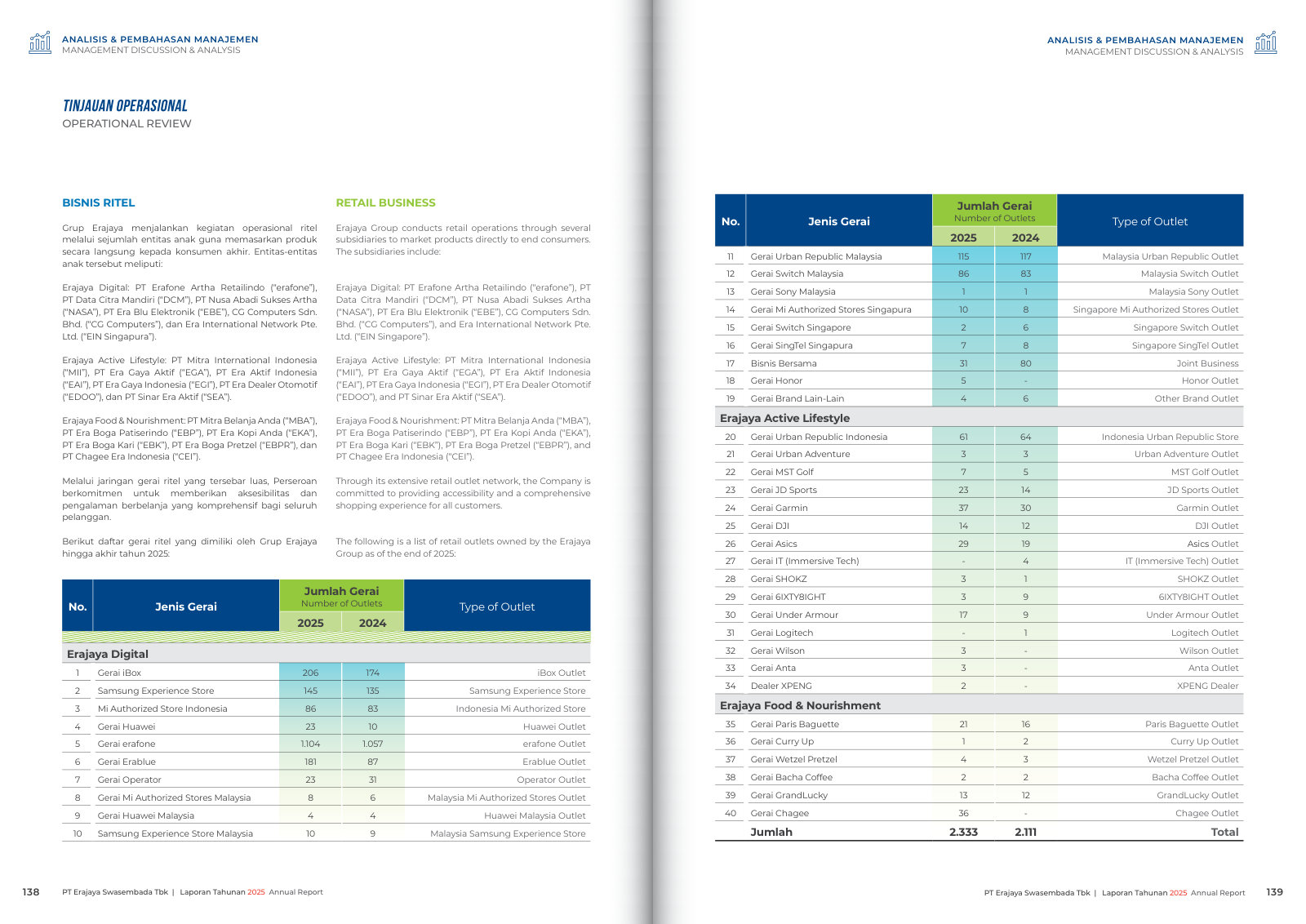
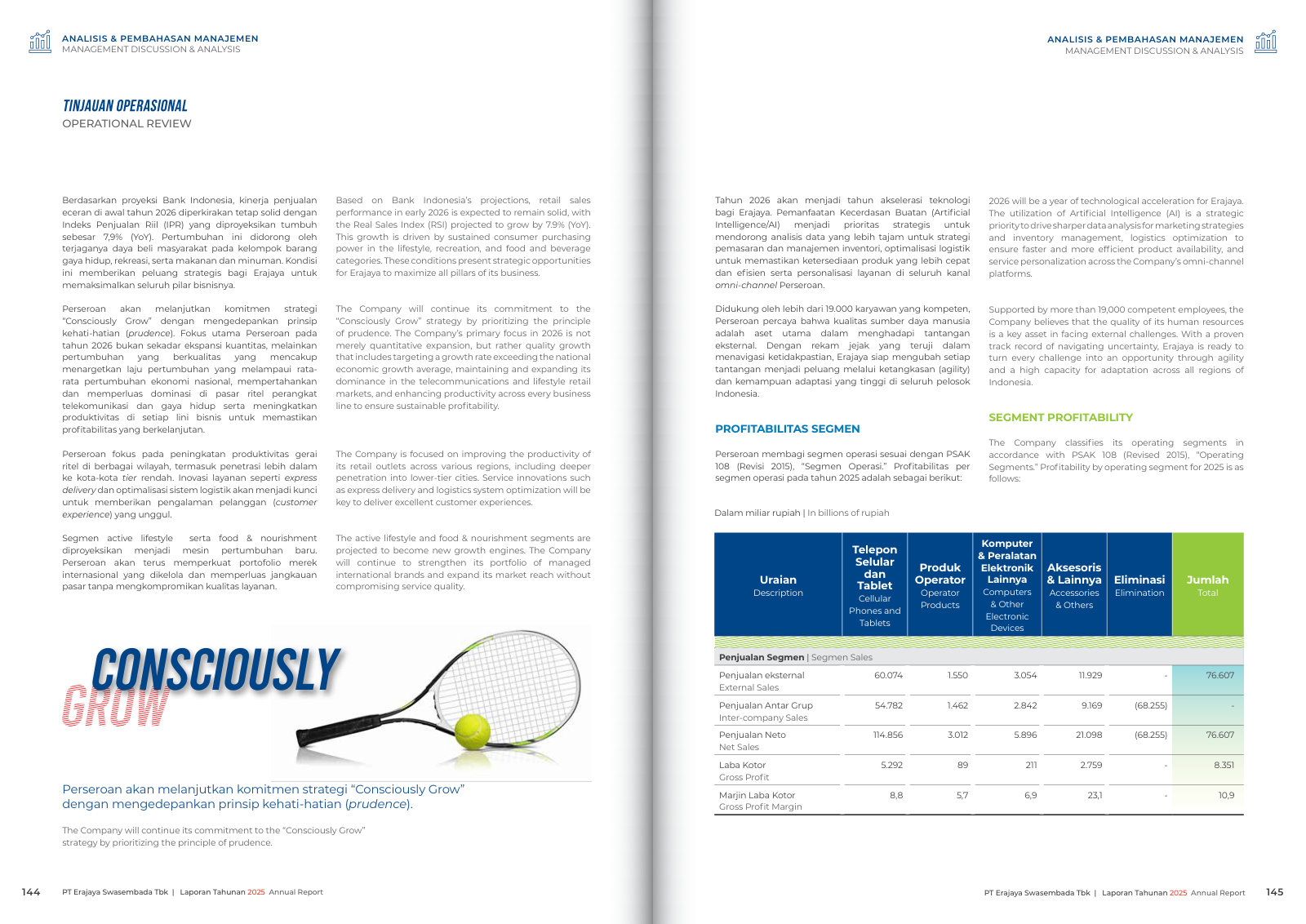
Where the money is actually made: banner-by-banner store counts, and the segment gross margins behind a 10.9% blended rate.
TINJAUAN KEUANGAN / FINANCIAL OVERVIEW — p. 75 · Read the full section →
The income statement walk — sales up 17.4% while selling and distribution costs rose 27.8%, compressing the gross margin.
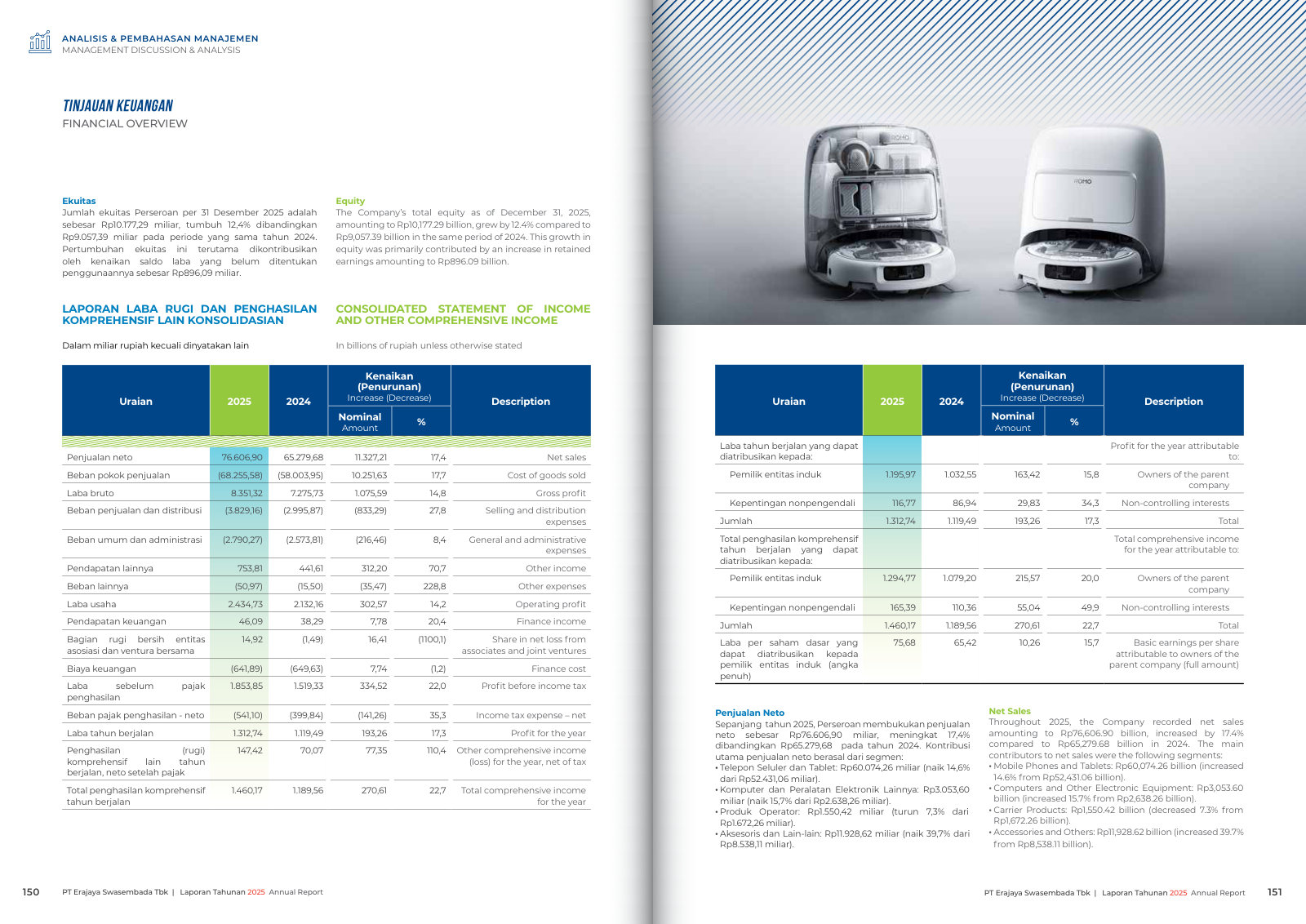
Selling and distribution expenses grew faster than sales.
Sales and distribution expenses increased by 27.8% from Rp2,995.87 billion to Rp3,829.16 billion. This increase was primarily caused by the increase of payroll expenses, depreciation of right-of-use assets, and advertising and promotional costs, which collectively increased by Rp586.28 billion or 30.3%.
p. 78 · Read in context →
LAPORAN ARUS KAS KONSOLIDASIAN / STATEMENT OF CONSOLIDATED CASH FLOWS — p. 78 · Read the full section →
The year's sharpest number: operating cash flow fell from Rp2,239bn to Rp225bn even as profit rose 17.3%.
Cash from customers rose Rp10.8tn; net operating cash flow fell 89.9%.
The Company recorded cash flows from operating activities consisting of cash receipts from customers amounting to Rp76,266.37 billion (2024: Rp65,461.88 billion). In addition, there were cash receipts from interest income amounting to Rp46.09 billion (2024: Rp38.29 billion). […] Meanwhile, cash used in operating activities consisted of cash payments to suppliers and employees totaling Rp74,945.44 billion.
Net cash provided by operating activities as of the end of 2025 amounting to Rp225.15 billion (2024: Rp2,239.32 billion).
p. 79 · Read in context →
KEMAMPUAN MEMBAYAR UTANG DAN TINGKAT KOLEKTABILITAS PIUTANG / SOLVENCY AND RECEIVABLES COLLECTIBILITY — p. 79 · Read the full section →
The balance-sheet cost of the expansion: current ratio down to 1.16x and debt-to-equity up from 1.40x to 1.84x.
Current liabilities outgrew current assets; the cash ratio fell to 0.12x.
The current ratio decreased from 1.22x in 2024 to 1.16x due to a 57.75% increase in current liabilities, while current assets increased by only 49.49% compared to the previous year. Meanwhile, the cash ratio decreased from 0.16x to 0.12x due to relatively stable cash and cash equivalents.
p. 79 · Read in context →
Leverage: liabilities up 46.88% against equity up 12.36%.
The debt-to-equity ratio stood at 1.84x, higher than 1.40x in 2024. Meanwhile, the debt-to-assets ratio was 0.65x, higher than 0.58x in the previous year. This increase occurred due to the increase in the Company’s liabilities by 46.88% and the increase in assets by 32.53%. Meanwhile, equity only increased by 12.36%.
p. 80 · Read in context →
SISTEM MANAJEMEN RISIKO / RISK MANAGEMENT SYSTEM — p. 128 · Read the full section →
Two risks specific to this importer: FX on stock bought in dollars, and import rules that can strand premium inventory.
FX on imported goods plus the 12% VAT step-up, and the IMEI/TKDN import regime.
Global economic uncertainty, which impacts fluctuations in the Rupiah exchange rate against the US Dollar, remains a key risk, considering that the majority of electronic products marketed are imported goods or contain cost components denominated in foreign currencies. In 2025, additional pressure arose from the potential decline in consumer purchasing power due to the adjustment of the Value Added Tax (VAT) rate to 12%, which began to be widely implemented. […] The Company operates within a dynamic regulatory framework, including policies on import trade procedures, IMEI registration, and Domestic Component Level (TKDN) requirements. Changes in import regulations (such as non-tariff restrictions) in 2025 may affect the availability of premium product inventory across the Company's retail network.
p. 128 · Read in context →
PT Erajaya Swasembada Tbk — 2024 Annual Report (Laporan Tahunan) — FY2024
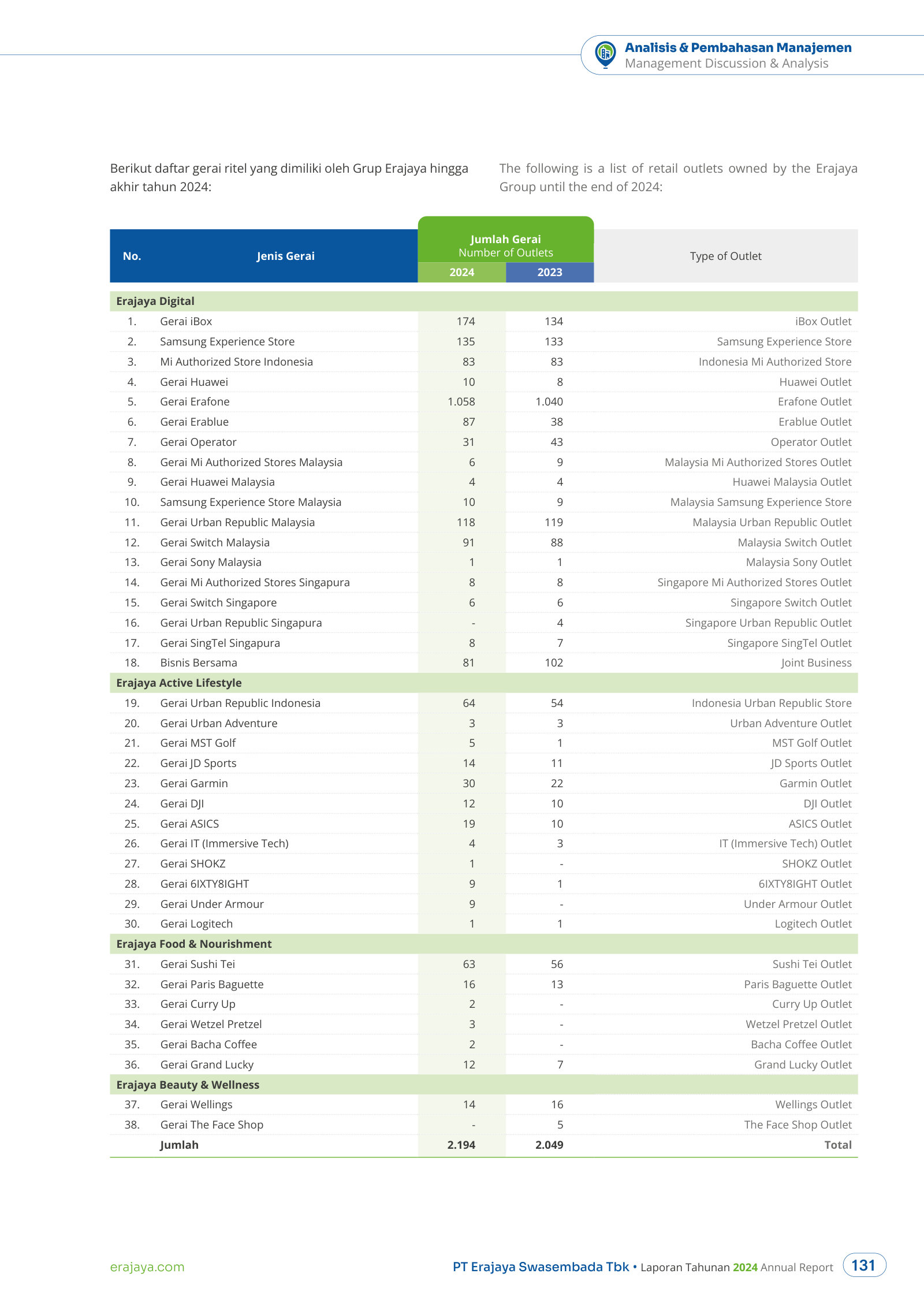
Featured for one contrast: FY2024 describes four verticals and lists banners — Wellings, The Face Shop, Sushi Tei — absent from the FY2025 report. · Open the full document →
Tinjauan Operasional / Operational Review — p. 128 · Read the full section →
The portfolio as management framed it a year earlier, before Beauty & Wellness disappeared from the vertical structure.
FY2024's pull-quote names four verticals, including Erajaya Beauty & Wellness.
“Erajaya Group engages in its business activities as importers, distributors, and retailers of telecommunication devices. By basing its business on customers, or “customercentric” business, the Company actively expands its business lines by opening new categories through 4 business verticals,namely: Erajaya Digital, Erajaya Beauty & Wellness,Erajaya Active Lifestyle, and Erajaya Food & Nourishment.”
p. 128 · Read in context →
More annual reports
PT Erajaya Swasembada Tbk — 2023 Annual Report (Laporan Tahunan) — FY2023 · 518 pages · Four verticals and 2,049 outlets: the year net sales grew 21.6% and subsidiary Sinar Eka Selaras was floated on the IDX as ERAL. · Open →
PT Erajaya Swasembada Tbk — 2022 Annual Report (Laporan Tahunan) — FY2022 · 526 pages · The four-vertical structure at Rp49.5tn of net sales — the base year for everything the 2025 report compares against. · Open →
PT Erajaya Swasembada Tbk — 2021 Annual Report (Laporan Tahunan) — FY2021 · 478 pages · The year the Active Lifestyle (JD Sports JV, August 2021) and Beauty & Wellness (Caring Pharmacy JV, November 2021) verticals were created. · Open →